




E-2 Visa Business Plan for U.S. Market Entry
Structured business plans with 5-Year Financial Projections, Investment Logic, Hiring Strategy, and Non-Marginality support for E-2 visa applications and USCIS review.
Get a free consultation for your project or situation
Structured Around USCIS Logic and Matter of Ho Principles
We do not replace an immigration attorney and do not provide legal advice. Our role is to develop the business and financial structure of the project: the E-2 Visa Business Plan, financial model, investment structure, and business viability logic.
The document is structured around key E-2 criteria, including substantial investment, at-risk capital, real and operating enterprise, direct and develop, job creation strategy, and Non-Marginality.
We also apply the principles of comprehensive investment business planning commonly associated with Matter of Ho, including market analysis, marketing strategy, organizational structure, personnel planning, and 5-Year Financial Projections.


For an E-2 investor visa, a business plan must demonstrate more than just an idea. It should present a structured business logic behind the project: the investment amount, operational viability, financial sustainability, hiring strategy, and the company’s ability to grow in the U.S. market.
This document is not created “for presentation purposes.” Its goal is to help the immigration attorney, USCIS officer, or consular officer clearly understand the relationship between the investment, business model, market opportunity, job creation strategy, and financial projections.
Entrepreneurs Launching a Business in the U.S.
When the project needs to demonstrate a real revenue model, market potential, and a structured growth strategy.
Investors Acquiring a Business or Franchise
When it is important to justify the investment amount, operational structure, and long-term financial viability of the business.
Clients Working with Immigration Attorneys
When the attorney requires a structured E-2 Visa Business Plan with financial projections, hiring strategy, and Non-Marginality support.
Families Planning Business-Based Relocation
When the business becomes the foundation for the E-2 visa application and long-term development in the United States.
E-2 Business Plan Is More Than a Business Description
Who Needs an E-2 Visa Business Plan
What Is Included in the E-2 Visa Business Plan
Overview of the Main Sections:
Executive Summary
Investor Profile
Company Overview
Investment Structure
Products & Services
U.S. Market Analysis
Marketing & Sales Strategy
Management & Personnel Plan
5-Year Financial Projections
Non-Marginality Statement
Supporting Evidence
Financial Model and 5-Year Financial Projections
For an E-2 Visa Business Plan, the financial model is not just a formality — it is one of the key elements used to evaluate the project. Financial projections help demonstrate how the business will operate in the United States, how profitability is generated, when the company reaches operating profitability, and how the foundation for long-term growth is created.
We develop 5-Year Financial Projections based on the business structure, selected state, sales model, hiring plan, operating expenses, and investment load of the project.
The financial model helps demonstrate:
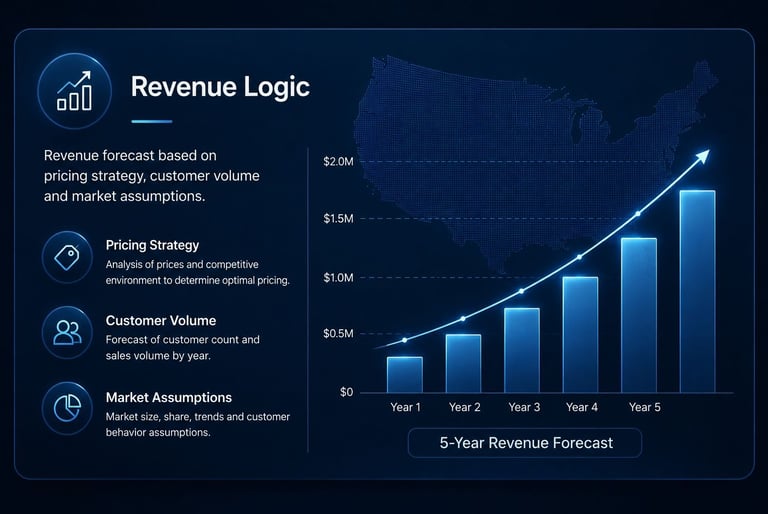
Revenue Logic
Revenue forecast based on pricing strategy, customer volume, and market assumptions.

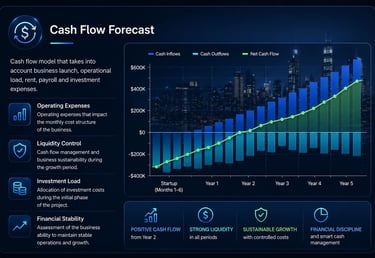
Cash Flow Forecast
for E-2 Visa Business Plan - cash flow model, operating expenses, rent, payroll, investment load, and financial stability analysis for the U.S. market.
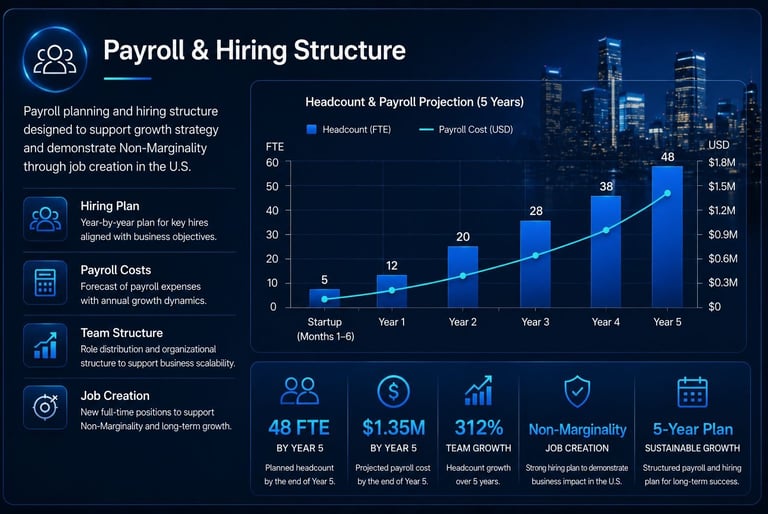
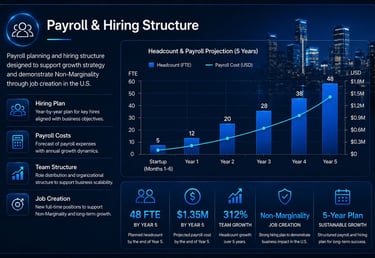
Payroll & Hiring Structure
Connection between the staffing plan, payroll costs, and Non-Marginality logic.
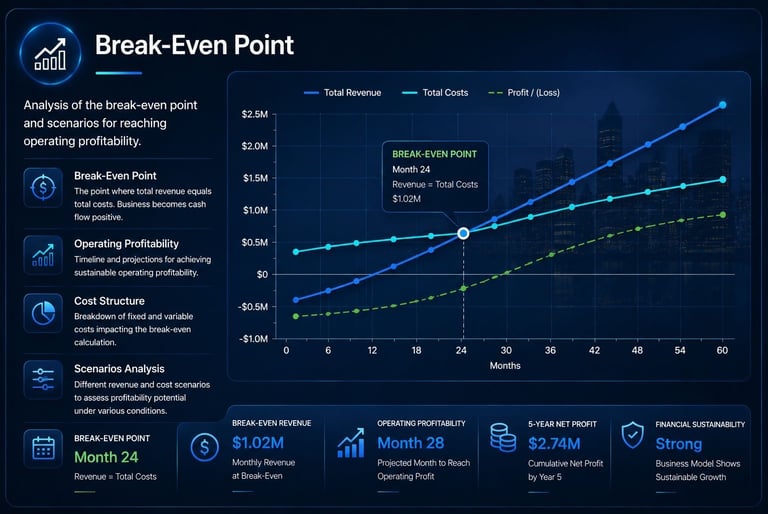
Break-Even Analysis
The point at which the business begins to demonstrate its financial viability and operational sustainability.
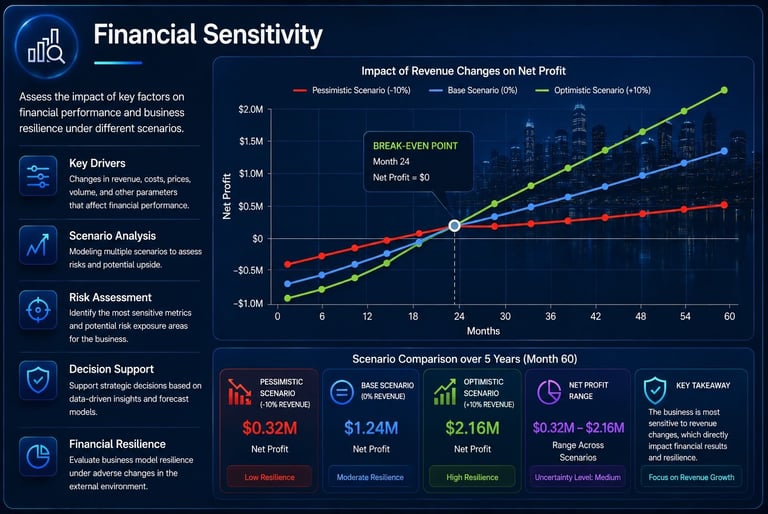
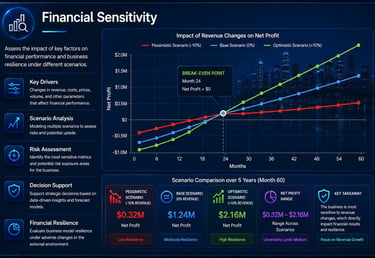
Financial Sensitivity
Analysis of how changes in revenue, costs, and market conditions affect the project’s financial stability.
For an E-2 Visa Business Plan, it is important to demonstrate not only the investment itself, but also the company’s ability to operate and grow as a real operating enterprise in the United States.
One of the key USCIS criteria is Non-Marginality — the ability of the business to generate income beyond supporting the investor personally and to create economic activity within the U.S. market. This is why the Hiring Plan and staffing strategy become an essential part of E-2 business planning.
As part of the E-2 visa application process, it is important to show that the business has a real management structure, hiring potential, and the ability to maintain operating profitability without signs of marginality. Therefore, the staffing model and hiring projections are integrated into the financial model, operational structure, and long-term business strategy of the project.
Hiring Plan and Non-Marginality
An E-2 Visa Business Plan is part of a broader immigration strategy, which is why business planning is often developed in coordination with an immigration attorney.
Our role is to prepare the business and financial structure of the project: financial projections, investment logic, hiring plan, operational model, and business viability support for the E-2 visa application.
We do not replace an immigration attorney and do not provide legal advice. Merser PL focuses on the business and financial side of the project, helping the attorney build a stronger and more structured package for USCIS or consular submission.
In many cases, the immigration attorney is responsible for the legal strategy, while the business plan specialist develops the financial projections, market analysis, hiring structure, and investment logic of the project. This approach helps create a more consistent E-2 Visa Business Plan and reduces the likelihood of additional questions during case review.
Collaboration with Immigration Attorneys
+48 504 236 955

Want a preliminary assessment of your situation?
We work online with clients worldwide
Ihar Lahotski
Business Engineering | B2B Consultant | E-2 Business Planning
1. How Much Investment Is Usually Needed for an E-2 Business Plan?
There is no fixed minimum investment amount for an E-2 visa. What matters is whether the investment appears reasonable and sufficient for the specific type of business: rent, equipment, launch costs, marketing, initial operating expenses, and working capital reserve.
We evaluate not only the amount itself, but also how it connects to the business model. For one project, $80,000 may be fully reasonable, while for another it may not be enough.
2. Can I Apply for E-2 If the Business Is Not Operating Yet?
Yes. Many E-2 projects are still at the launch stage. However, it is important to demonstrate that the project is more than just an idea: company formation, investments, lease agreements, operational planning, financial projections, and a realistic launch strategy.
The business plan helps organize all of this into a structured and understandable system.
3. What If Part of the Investment Has Already Been Spent and Part Is Still on the Account?
This is a normal situation. We separate expenses into already invested, committed, and planned expenses.
The important part is showing which costs are already connected to the business, which funds are reserved for launch activities, and how the overall investment supports business development.
4. How Do You Show That the Investment Is Truly “At Risk”?
Supporting documentation is important: invoices, receipts, lease agreements, equipment quotes, contracts, deposits, and bank statements.
Within the business plan, we explain how these funds are connected to real business operations and launch activities. The investment should appear as active capital committed to an operating enterprise — not passive savings.
5. Is It Necessary to Hire Employees During the First Year?
It depends on the business model. However, for E-2 purposes, it is important to show that the project is not simply self-employment for the investor.
If hiring during the first year is realistic, it strengthens the case. If not, the hiring plan for later stages should be carefully connected to business growth projections.
6. What If the Business Plan Shows Profitability but Only a Small Team?
Profitability itself is important, but E-2 cases also involve the concept of Non-Marginality — meaning the business should have growth potential and contribute economically beyond supporting the investor personally.
If the staffing structure is small, the business plan must more clearly demonstrate growth strategy, market opportunity, operational scalability, and future hiring potential.
7. Can the Immigration Attorney Request Revisions to the Business Plan?
Yes. This is a normal part of the process. The immigration attorney may request adjustments to investment logic, hiring strategy, operational details, or financial projections.
We expect working revisions during the preparation process so the business plan aligns with the overall legal strategy of the case.
8. How Can Financial Projections Avoid Looking Unrealistic or Artificial?
Financial projections should always be connected to real assumptions: pricing, customer volume, expenses, market conditions, marketing strategy, and hiring plans.
We do not create unsupported numbers. The financial model must logically explain where revenue comes from, how expenses are structured, and when the business reaches sustainable profitability.
9. Can the Business Plan Be Used for Buying a Franchise or Existing Business?
Yes. In many cases, franchise acquisitions or existing businesses provide an even stronger operational foundation because there is already an established model, market demand, and operating structure.
In these situations, the business plan is adapted around the acquisition terms, investment structure, financial performance, and future development strategy.
10. What Is Your Role and What Does the Immigration Attorney Handle?
We prepare the business and financial side of the project: the E-2 Visa Business Plan, financial projections, investment structure, hiring plan, market analysis, and business model logic.
The immigration attorney handles the legal strategy, immigration filing, and final submission process. The strongest results usually come when these two parts work together.
11. Can We Evaluate the Idea and Financial Logic Before Ordering a Full E-2 Business Plan?
Yes. In many cases, this is a very reasonable first step.
An initial review can help assess the investment amount, business model, expense structure, hiring plan, and overall financial logic of the project. Sometimes this stage already shows where the project needs strengthening before developing the full E-2 Visa Business Plan.
FAQ - E-2 Visa Business Plan


Clarity Before You Start
When the idea already exists, but there is still no clear roadmap, no financial clarity, and no real understanding of how to move forward.


Numbers, Not Guesswork
When it is important to understand the required investment, launch timing, risks, and the real financial picture of the project.


Financial Justification for External Funding
When your business needs funding for launch and growth, and the project must be supported by clear financial logic and well-grounded calculations.


Justifying Your Project to Others
When your idea needs to be clearly and convincingly presented to partners, investors, banks, or your team.


Reduce the Risk of Mistakes
When it is important to identify weak points in advance and avoid financial losses at the launch stage.


A System Instead of Chaos
When there are many ideas, but no clear structure, priorities, or sequence of actions.
Want a preliminary assessment of your situation?
An E-2 Visa Business Plan is just one example of where a structured business and financial model is required.
Depending on the client’s goals, a business plan may also be used for:
entering the U.S. market
launching a new business
attracting investors
acquiring a franchise or existing business
evaluating the financial stability of a project
negotiations with banks or business partners
scaling an existing business
developing a growth strategy and operational structure
In some cases, the process starts not with preparing the full E-2 Visa Business Plan, but with evaluating the idea itself, the investment logic, and the overall viability of the project.